Workers compensation laws in NSW have changed from 1 July 2026.
If you are a medical or health provider treating a worker with a work-related injury, there are new rules and processes that affect how claims are assessed, and how your clinical information is used to support decision-making.
I am a counsellor or psychologist
What’s changed for me?
New requirements apply to primary psychological injuries first notified on or after 1 July 2026.
To be compensable, a primary psychological injury must:
- be caused by a relevant event (or series of relevant events)
- have a real and direct connection to employment
- have employment as the main contributing factor.
As a counsellor or psychologist, your diagnosis, treatment records and clinical information may help insurers determine whether a claim meets these requirements and which claims pathway applies.
What to do
- Provide a clear diagnosis and explain how the psychological condition relates to the reported work-related event or conduct.
- Identify the relevant event or conduct, where clinically appropriate.
- Describe the worker’s functional capacity, treatment goals and expected recovery outcomes.
- Provide information that is relevant to the worker’s injury, treatment and recovery.
- Review treatment regularly and provide updated information if the worker’s condition or capacity changes.
Important updates
- A relevant event is a work-related event that can cause a compensable primary psychological injury. Relevant events include:
- acts or threats of violence
- serious criminal conduct
- witnessing traumatic incidents
- death of a person in the worker’s care with additional requirements outlined in the legislation
- vicarious trauma
- sexual harassment
- racial harassment
- bullying
- excessive work demands.
- Relevant conduct is a category of relevant event that includes:
- bullying
- sexual harassment
- racial harassment
- excessive work demands.
- Relevant conduct claims follow a different claims pathway from claims involving other relevant events.
- Each relevant event has specific definitions in the legislation and regulations.
- For claims involving relevant conduct, a completed claim form and minimum information are required before the claim can proceed.
- Insurers have 42 days to determine liability for relevant conduct claims once the minimum information is received.
- During the determination period, workers may receive interim entitlement payments and up to $7,500 for medical or related treatment.
- For primary psychological injuries, new whole person impairment thresholds affect access to weekly payments, medical and related treatment, and work injury damages.
- Psychological injuries caused only by general work pressure or interpersonal conflict are not compensable unless they meet the relevant event requirements
- These changes do not apply to:
- exempt workers, including police officers, paramedics and firefighters.
- coal miners, volunteers and claims for dust diseases.
- primary psychological injuries notified before 1 July 2026.
- secondary psychological injuries that arise because of a physical injury.
Links
Psychological injuries guidance
Permanent impairment factsheet
A quick guide to workers compensation
I am an allied health practitioner who treats physical injuries
What’s changed for me?
For physical allied health practitioners, there are limited changes from 1 July 2026. The main changes relate to permanent impairment assessments and some worker entitlements.
Your clinical information continues to play an important role in workers compensation decisions. Treatment and services should be clearly linked to the worker’s claimed injury and supported by clinical information that demonstrates progress, functional improvement and recovery.
What to do
- Explain why treatment is needed and how it relates to the worker’s claimed injury.
- Use standardised outcome measures or other clinical evidence, where appropriate, to demonstrate progress and functional improvement.
- Set clear treatment goals, expected outcomes and review points.
- Provide information that supports timely treatment decisions and recovery at work.
- Review treatment regularly and provide updated information if the worker's condition or capacity changes.
Important updates
- New permanent impairment assessment arrangements commenced on 1 July 2026 and may affect a worker's entitlements.
Links
A quick guide to workers compensation
Psychological injuries guidance
Permanent Impairment – Single Assessment
Workers compensation guidelines
I am a medico-legal provider
What’s changed for me?
From July 2026, new rules apply to permanent impairment assessments.
A worker is generally entitled to a single assessment to determine the degree of permanent impairment for an injury, or injuries arising from the same incident. The assessment outcome may be used to determine entitlements such as weekly payments, medical and related treatment, lump sum compensation, commutations and work injury damages.
These changes do not apply to:
- exempt workers, including police officers, paramedics and firefighters
- coal miners
- volunteers
- claims for dust diseases.
What to do
- Conduct assessments in accordance with the NSW Workers Compensation Guidelines for the Evaluation of Permanent Impairment in force at the time of assessment.
- Ensure assessment reports clearly explain the evidence considered, findings reached and reasons for the assessment outcome.
- Be aware that assessments cannot be performed where liability for the injury has not been determined.
- When a further assessment is requested, consider whether the available evidence supports an unexpected and material deterioration in the worker’s condition.
Important updates
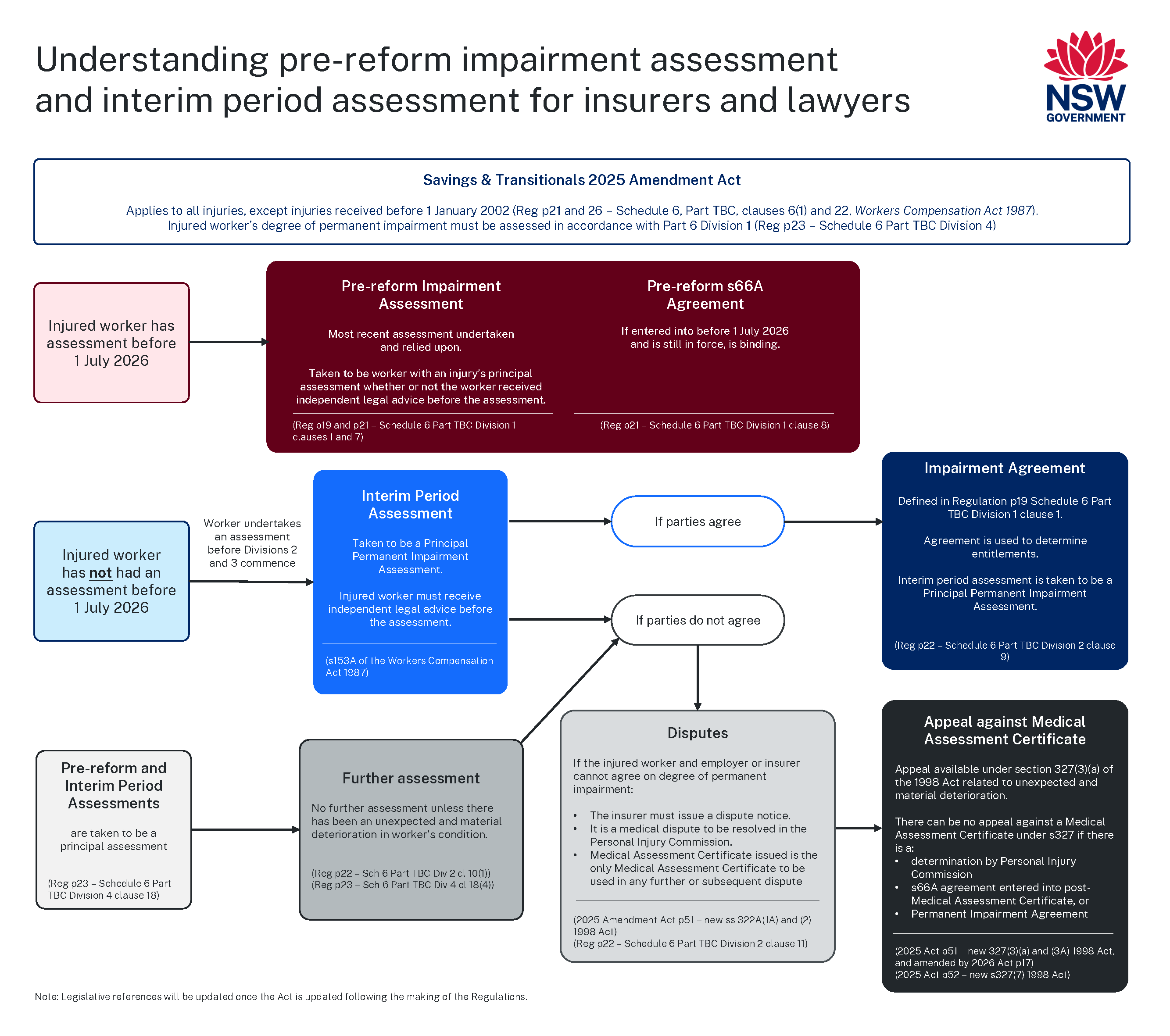
- During the period from 1 July 2026 to mid-2027 (the interim period), assessments are conducted by assessors on the current SIRA register and are treated as the worker’s principal assessment. The assessment is used for an impairment agreement that determines the worker's entitlements. A further assessment may only occur in limited circumstances, including where there has been an unexpected and material deterioration that increases the worker's degree of permanent impairment by at least 10 percentage points.
- Workers must obtain independent legal advice before a permanent impairment assessment is undertaken.
- Further changes are coming in mid-2027, including a new joint assessment process and updated approval requirements for permanent impairment assessors. More information will be available before June 2027.
- The Psychiatric Impairment Rating Scale is being reviewed to assess its effectiveness and appropriateness for psychological impairment assessments.
Links
NSW Workers Compensation Guidelines for the Evaluation of Permanent Impairment
Pre-interim period assessment flowchart
Permanent impairment assessment factsheet
Permanent impairment - single assessment
I am a medical practitoner or specialist
What's changed for me?
Medical practitioners play a key role in diagnosing workers with an injury, issuing certificates of capacity, planning treatment and supporting recovery at work. Your clinical information helps insurers make decisions about liability, work capacity, treatment approval and worker entitlements.
From 1 July 2026, changes to primary psychological injury claims, treatment entitlements, COVID-19 certification, employer attendance at medical appointments and permanent impairment assessments may affect how these decisions are made.
These changes do not apply to:
- exempt workers, including police officers, paramedics and firefighters
- coal miners, volunteers or claims for dust diseases
- primary psychological injury changes do not apply to injuries notified before 1 July 2026
- secondary psychological injuries that arise because of a physical injury.
What to do
- Issue a certificate of capacity, where relevant, that includes diagnosis, treatment plan and functional capacity for work.
- For primary psychological injury claims, provide clear clinical information about the diagnosed mental or psychiatric disorder and how it relates to the reported work-related event or conduct.
- Describe what the worker can safely do, including hours, duties and restrictions.
- For work-related COVID-19 claims, certify the period of incapacity that is clinically appropriate for the worker.
- If a worker asks an employer or employer representative to attend a medical appointment, confirm the worker’s request before the appointment proceeds. This does not apply to exempt workers, coal miners, volunteers or claims for dust diseases.
Important updates
- For primary psychological injuries notified on or after 1 July 2026, the injury must be caused by a relevant event, have a real and direct connection to employment, and employment must be the main contributing factor.
- A relevant event is a work-related event that can cause a compensable primary psychological injury. Relevant events include:
- acts or threats of violence
- serious criminal conduct
- witnessing traumatic incidents
- death of a person in the worker’s care (with additional requirements outlined in the legislation)
- vicarious trauma
- sexual harassment
- racial harassment
- bullying
- excessive work demands.
- Relevant conduct is a category of relevant events that includes:
- bullying
- sexual harassment
- racial harassment
- excessive work demands.
- Relevant conduct claims follow a different claims pathway from claims involving other relevant events.
- For claims involving relevant conduct, a completed claim form and minimum required information must be provided before the claim can proceed.
- For primary psychological injuries, entitlement to medical and related treatment is generally limited to 1 year after weekly payments cease, or 1 year from the date of claim if no weekly payments are made, unless the worker has highest needs.
- Employers and their representatives cannot attend a worker’s medical treatment or examination unless the worker asks them to attend.
- A case conference can still be arranged to support recovery and return to work planning, but it should be scheduled separately from treatment or examination unless requested by the worker.
- For work-related COVID-19 diagnoses, incapacity is based on the period specified on the Certificate of Capacity.
- Permanent impairment assessments may affect a worker’s entitlement to weekly payments, medical and related treatment, lump sum compensation, commutations and work injury damages.
Links
A general guide to workers compensation for medical practitioners
A quick guide to workers compensation
Psychological injuries guidance
Permanent impairment factsheet
Permanent impairment – single assessment
Employer attendance at medical examinations & treatment
I am a workplace rehabilitation provider
What's changed for me?
Workplace rehabilitation providers support safe and sustainable recovery at work. Your role may include helping the worker, employer, insurer and treating providers identify suitable duties, clarify capacity and address barriers to recovery and return to work.
From 1 July 2026, changes to primary psychological injury claims mean that timely, relevant and coordinated information is needed to support claim and recovery decisions.
These changes do not apply to:
- exempt workers, including police officers, paramedics and firefighters
- coal miners, volunteers and claims for dust diseases.
- primary psychological injuries notified before 1 July 2026
- secondary psychological injuries that arise because of a physical injury.
What to do
- Check the worker’s claim type and worker cohort before applying the new requirements.
- Work with the worker, employer, insurer and treating providers to support safe recovery at work.
- Use clinical information and capacity guidance to identify suitable duties and practical workplace supports.
- Focus on what the worker can do safely, including hours, duties, restrictions and supports needed at work.
- Document agreed goals, actions, responsibilities and timeframes, for recovery at work.
- Share only information that is relevant to the worker’s injury, recovery and return to work, and ensure appropriate consent is in place.
Important updates
- Employers and employer representatives cannot attend a worker’s medical treatment or examination unless the worker asks them to attend. This does not apply to exempt workers, coal miners, volunteers or claims for dust diseases.
- A case conference may still be arranged to support recovery and return to work planning, but it should be separate from medical treatment or examination unless requested by the worker.
- For primary psychological injuries notified on or after 1 July 2026, the injury must be caused by a relevant event, have a real and direct connection to employment, and employment must be the main contributing factor.
- A relevant event is a work-related event that can cause a compensable primary psychological injury. Relevant events include:
- acts or threats of violence
- serious criminal conduct
- witnessing traumatic incidents
- death of a person in the worker’s care (with additional requirements outlined in the legislation)
- vicarious trauma
- sexual harassment
- racial harassment
- bullying
- excessive work demands.
- Relevant conduct is a category of relevant events that includes:
- bullying
- sexual harassment
- racial harassment
- excessive work demands.
- Relevant conduct claims follow a different claims pathway from claims involving other relevant events. For primary psychological injuries, the claim pathway may affect the timing and type of information needed to support recovery at work.
- Clear functional information helps employers identify suitable work and helps insurers make timely decisions about recovery and return to work. Treatment and rehabilitation recommendations should be linked to the work injury and support functional improvement, recovery and return to work.
Links
A quick guide to workers compensation
Workers compensation guidance for employers
Psychological injuries guidance
Employer attendance at medical examinations & treatment
Updated 7 July 2026