Workers compensation laws in NSW changed from 1 July 2026.
If you are an employer, there are new rules and processes for supporting workers with an injury, managing claims, and meeting your obligations.
What injuries do I need to notify to my insurer ?
What this means
If a worker is injured at work, you have immediate obligations under workers compensation laws. An employer is required to notify any workplace injury to their insurer within 48 hours of becoming aware. Reporting timeframes are unchanged.
What to do
- Provide first aid and urgent medical treatment if needed.
- Record the injury in your register of injuries.
- Tell your worker (or their representative) the name of your insurer and how to contact them.
- Report the injury to your insurer within 48 hours of becoming aware.
- Provide the insurer with the necessary information listed in Part 1 of the Workers Compensation Guidelines.
- For a psychological injury:
- Tell your worker that the claim form must be completed and submitted to the insurer.
- Nominate the relevant event(s) that caused the injury.
Relevant events include
- act of violence or threats of violence
- indictable criminal conduct
- witnessing a traumatic incident
- vicarious trauma
- the death of a person in your care
- bullying
- sexual harassment
- racial harassment
- excessive work demands.
Links
- Workers Compensation Guidelines
- Claim form for psychological injury caused by relevant conduct
- Step-by-step guide for responding to a work-related injury
What to do if there’s been a work-related injury – For employers
- Comprehensive employer guide to workers compensation
- Psychological Injuries Guidance
I have a worker who has been injured at work - what do I need to do first?
What this means
If a worker is injured at work, you have immediate obligations under workers compensation laws. Acting quickly helps your worker recover and ensures you meet your legal requirements.
What to do
- Provide first aid and urgent medical treatment if needed.
- Record the injury in your register of injuries.
- Tell the worker (or their representative) the name of your insurer and how to contact them.
- Report the injury to your insurer within 48 hours of becoming aware. If the worker has a psychological injury, you will need to select which relevant event/s caused the injury.
- For psychological injuries caused by relevant conduct, let the worker know a claim form must be completed and submitted to the insurer.
- Tell the worker about support available to recover at work (if appropriate).
- Start thinking about duties you can provide to the worker to support recovery.
What is a relevant event?
A relevant event is a specific incident or situation at work that can cause a psychological injury. This includes:
- Relevant conduct: bullying, sexual harassment, racial harassment, or excessive work demands.
- All other relevant events: violence, serious criminal conduct, witnessing trauma, death in care, or vicarious trauma.
Important updates
- Reporting timeframes are unchanged, but for psychological injury claims, you will need to include the relevant event that caused the injury when notifying the insurer of the injury.
- If the cause of the injury was bullying, sexual or racial harassment or excessive work demands (known as relevant conduct) the worker is required to complete a claim form.
Relevant links
- Step-by-step guide for responding to a work-related injury
What to do if there’s been a work-related injury – For employers
- Comprehensive employer guide to workers compensation
- Psychological Injuries Guidance
- Claim form for psychological injury caused by relevant conduct
- Practical support for small businesses
I am supporting a worker to recover at work
What this means
Helping the worker recover at work is one of your most important obligations. Early, supportive contact and suitable duties can speed up recovery, and improve outcomes for both your worker and your business and reduce costs.
What to do
- Stay in regular contact with the worker and their support team (insurer, doctor, rehabilitation provider).
- Identify suitable duties and adjust work tasks or hours to match your worker’s capacity.
- Develop a written recover at work plan in consultation with the worker and their treating doctor.
- Provide information about the workplace and available duties to the support team.
- Encourage the worker to participate in planning and decision-making about their recovery.
- Monitor progress and update the plan as the worker’s capacity changes.
Important updates
- Employers must provide suitable work where reasonably practicable. Maximum penalties for failing to do so have doubled from 50 to 100 penalty units (from $5,500 to $11,000).
- Employers and their representatives are not entitled to attend a worker’s medical treatment or medical examination unless the worker requests their attendance.
- This does not prevent employer participation in case conferences which are an important step to support return to work.
Relevant links
- Comprehensive employer guide to workers compensation
- Tools and templates for planning recovery at work
- Information about workplace rehabilitation providers
- SIRA-funded programs to support recovery at work
- Employer Attendance at medical examination
Employer not entitled to attend medical examination or treatment
I am managing a psychological injury claim
What this means
From 1 July 2026, there are new rules for psychological injury claims, including eligibility criteria, reporting requirements, and different processes for claims caused by relevant events and relevant conduct.
What is a relevant event?
A relevant event is a specific incident or situation at work that can cause a psychological injury. This includes:
- Relevant conduct: bullying, sexual harassment, racial harassment, or excessive work demands.
- All other relevant events: violence, serious criminal conduct, witnessing trauma, death in care, or vicarious trauma.
What to do
- You must notify the insurer within 48 hours of becoming aware that a worker has incurred any workplace psychological injury.
- Identify and record the relevant event that caused the injury (see above).
- If the psychological injury was caused by relevant conduct (bullying, sexual harassment, racial harassment, or excessive work demands):
- Ensure your worker completes and submits a claim form to the insurer.
- Let the worker know this process is different to other psychological injury claims.
- The insurer may provide interim entitlement payments (early weekly payments and medical expenses) while liability is determined.
- If the psychological injury was caused by another relevant event (such as violence, traumatic incident, vicarious trauma, or death in care):
- Follow the usual claims process.
- The insurer may provide provisional payments (early weekly payments and medical expenses) while liability is determined.
- Support the worker by providing information about recovery at work, suitable duties, and available support.
- Maintain open communication with the worker and their support team.
Important updates
- Psychological injury claims must be caused by a relevant event, with a real and direct connection to employment, and employment must be the main contributing factor.
- Claims caused by relevant conduct require a completed claim form and follow a different process than claims for psychological injuries caused by other types of relevant events (such as violence, traumatic incidents, vicarious trauma, or death in care).
- For relevant conduct claims:
- Provisional payments do not apply.
- Instead, workers may receive interim weekly payments and up to $7,500 in treatment expenses while the insurer decides liability during the determination period (up to 42 days).
What is the determination period?
The determination period is the time (up to 42 days for relevant conduct claims) during which the insurer assesses the claim and decides whether to accept or dispute liability.
- For psychological injuries caused by other relevant events (not relevant conduct), provisional payments may apply.
What are provisional payments?
Provisional payments are early payments made by the insurer before liability is formally accepted, to provide support for the worker (up to 12 weeks of weekly payments and up to $10,000 for medical treatment).
- Disputes about whether the conduct is ‘relevant conduct’ will be decided at the Industrial Relations Commission (IRC) if, after an internal review by the insurer, the reason for the claim is not accepted.
- General work pressure or interpersonal conflict are not compensable events under the new laws.
Relevant links
- Guidance for employers on psychological injury claims
- Information about relevant events and conduct
Key changes for employers - Workers compensation legislative reform 2026
- Psychological Injuries Guidance
- Claim form for psychological injury caused by relevant conduct
Providing information to my insurer
What this means
Employers are required to provide accurate information to their insurer for premium calculation, claims management, and compliance with workers compensation laws. New offences and penalties apply for not having a workers compensation policy or failing to provide information resulting in underinsurance.
What to do
- Provide your insurer with accurate wage and business information when applying for or renewing your workers compensation policy.
- Supply your insurer with estimated wages for the upcoming policy period within 2 months of application or renewal. Estimated wages are not required to be supplied by small employers at renewal.
- All employers (including small employers): Provide a full and correct declaration of actual wages paid within 4 months of the end of the policy period.
- For apprentices and younger workers whose wage is tied to birthdays or years of service, tell your insurer when those milestones are due.
- Keep, supply, and make available for inspection wage and other records as required.
- Respond promptly to any requests from your insurer for information about a worker’s injury or claim (within 7 days).
Important updates
- The maximum penalty for failing to hold a workers compensation policy has increased. There is also a new offence for recklessly failing to provide information relevant to premium calculation (under-insurance). The maximum penalties for both offences are:
- For large employers: the greater of 3 times the avoided premium or $110,000, plus up to 2 years imprisonment.
- For other employers: up to $55,000 and up to 6 months imprisonment.
Relevant links
- Guidance on employer obligations and penalties
Key changes for employers - Workers compensation legislative reform 2026
- How to get workers compensation insurance
- Factsheet for employers about under-insurance
Your legal obligations: Providing premium related information to your workers compensation insurer
- A Workers Compensation Guide
- For Small Businesses
- Submitting wage records to the workers compensation insurer
Your legal obligations: Providing premium related information to your workers compensation insurer
What the worker with an injury may be able to claim
What this means
Workers compensation provides a range of benefits and payments to support the worker if they are injured at work. What the worker can claim depends on the type and severity of their injury, and the circumstances of their claim.
What the worker with an injury may be able to claim (from 1 July 2026)
- Weekly payments: To compensate for lost income if your worker is unable to work or has reduced capacity due to a work-related injury. Payments are based on pre-injury average weekly earnings (PIAWE) and may change over time.
- Medical, hospital, and rehabilitation expenses: For treatment related to the injury, including doctor visits, specialist consultations, medications, scans, physiotherapy, psychology/counselling, and more. The “reasonably necessary” test still applies at commencement from 1 July 2026.
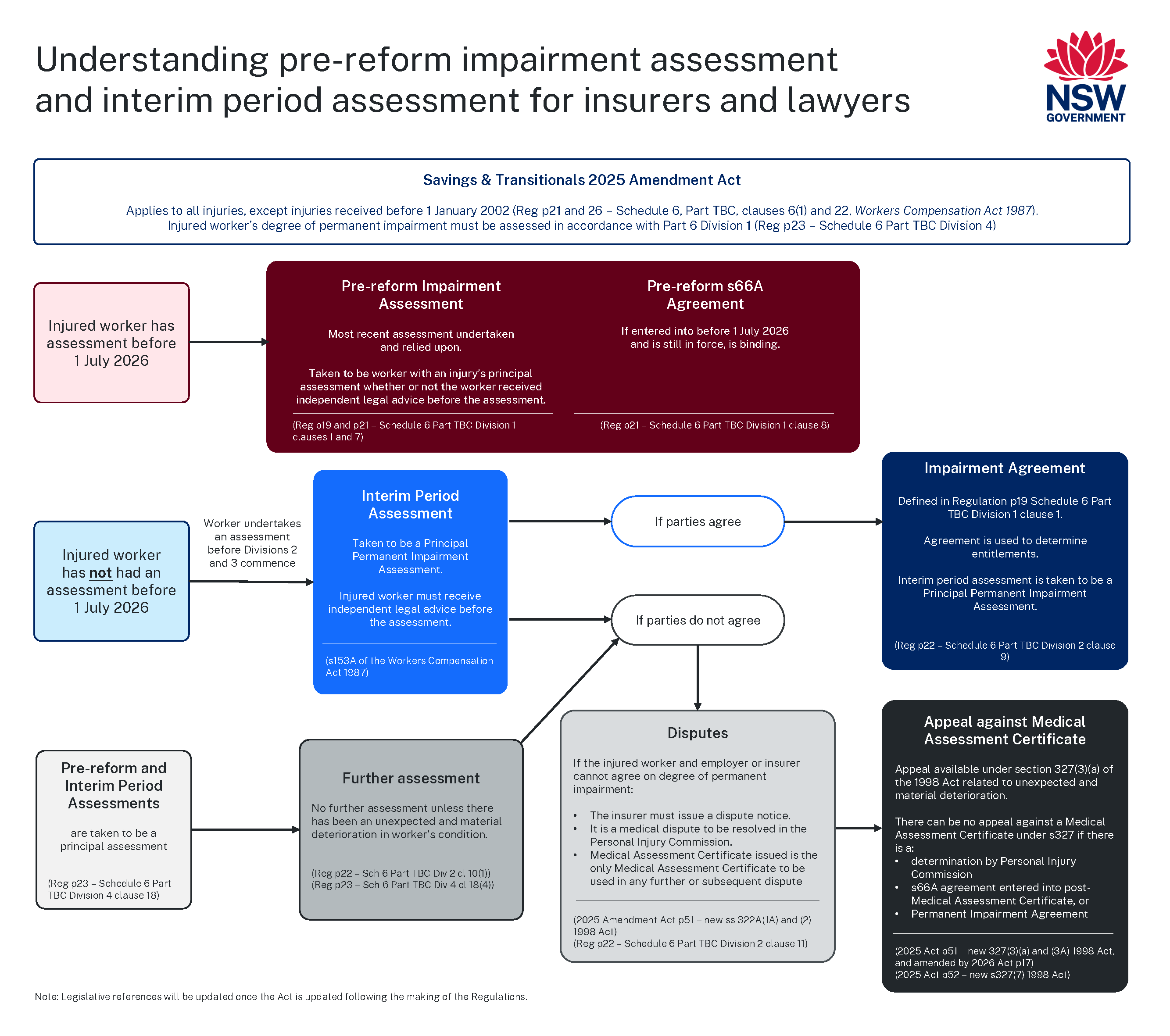
- Lump sum compensation: If the worker has a permanent impairment as a result of their injury, they may be eligible for a lump sum payment. This requires an assessment by a permanent impairment assessor. From 1 July 2026, most workers will generally have only 1 permanent impairment assessment per injury, and further assessments are only allowed in limited circumstances if the worker’s condition deteriorates.
- Property damage: Reasonable costs for repairing or replacing items damaged in a work-related accident (e.g. artificial aids, spectacles, clothing).
- Death benefits: If a worker dies as a result of a work-related injury, their dependants may be entitled to a lump sum payment, weekly payments for dependent children, and funeral expenses.
Important updates
- The rules for psychological injury claims, permanent impairment assessments, and some entitlements have changed from 1 July 2026.
- For psychological injuries caused by relevant conduct, a completed claim form is required, and the claims process is different from the process for psychological injuries caused by other relevant events (such as violence, witnessing traumatic incidents, vicarious trauma, or death in care).
- Most workers will generally have only 1 permanent impairment assessment per injury. Further assessment is only allowed in limited circumstances, such as if the injury is likely to result in a further significant deterioration.
- Workers must get independent legal advice before being assessed for permanent impairment. This is an important step so they know their rights before they take this option.
- Some entitlements and processes may change as reforms are implemented.
Relevant links
- Lump sum compensation and permanent impairment
- Property damage and death benefits
- Summary of key changes for employers
Key changes for employers - Workers compensation legislative reform 2026
Managing my premium and excess payments
What this means
Employers are responsible for paying workers compensation insurance premiums and providing accurate information to the insurer to ensure they can determine the appropriate premium. From 1 July 2026, there are new rules, penalties, and requirements for premium calculation and excess payments.
What to do
- Make sure your workers compensation policy is current and covers all employees.
- Provide accurate wage and business information to your insurer for premium calculation.
- Review your policy renewal dates and ensure compliance with new rules.
- Supply your insurer with estimated wages for the upcoming policy period within 2 months of application or renewal. Estimated wages are not required to be supplied by small employers at renewal.
- All employers (including small employers): Provide a full and correct declaration of actual wages paid within 4 months of the end of the policy period.
- If you are insured with icare or a specialised insurer (including Coal Mines Insurance), pay the increased excess for claims made against a policy issued or renewed on or after 4pm on 30 June 2026 (equal to the weekly payments paid to the worker in the first two weeks after becoming entitled to weekly payments).
Important updates
- The maximum penalty for failing to hold a workers compensation policy has increased. There is also a new offence for recklessly failing to provide information relevant to premium calculation (under-insurance). The maximum penalties for both offences are:
- For large employers: the greater of 3 times the avoided premium or $110,000, plus up to 2 years imprisonment.
- For other employers: up to $55,000 and up to 6 months imprisonment.
- Premium rates for employers insured by icare are frozen for 2026–27 and 2027–28, but individual premiums may still increase due to changes in wages, business activity, or claims experience.
- The increased excess payment requirement applies to claims made against a policy issued or renewed on or after 4pm on 30 June 2026. (For claims made against earlier policies, an excess of one week’s payment applies, however does not apply to small employers or where the injury is notified to the insurer within 5 days of the employer becoming aware of the injury.)
Links
- Guidance on employer obligations and penalties
Key changes for employers - Workers compensation legislative reform 2026
- How to get workers compensation insurance
- Factsheet for insurers about underinsurance
- A Workers Compensation Guide
- For Small Businesses
My obligations to provide suitable work to a worker with an injury
What this means
Employers are required to provide suitable work to a worker with an injury where reasonably practicable.
What to do
- Assess the worker’s capacity and review all available duties in your business.
- Consult with the worker, supervisor, other managers, and where relevant an approved workplace rehabilitation provider to identify suitable work options.
- If you cannot provide suitable duties, document your efforts (who you consulted, what options you considered, and any barriers you identified) and inform your insurer.
- Review the worker’s capacity regularly and reassess whether suitable duties can be offered as their condition changes.
- Actively participate in the recover at work planning process, even if suitable duties are not currently available.
Important update
- The maximum penalty for failing to provide suitable work has doubled from 50 to 100 penalty units (from $5,500 to $11,000) from 1 July 2026.
Relevant links
- Guidance for identifying suitable work
- Tools and templates for planning recovery at work
- Information about workplace rehabilitation providers
- SIRA-funded programs to support recovery at work
- Guidance for documenting efforts and compliance
Key changes for employers - Workers compensation legislative reform 2026
I am dealing with a dispute or complaint
What this means
Disputes or complaints may arise if you, the worker, or the insurer disagree about a claim, payments, treatment, or injury management. Employers have a role in supporting resolution and ensuring all parties understand their options.
What to do
- Encourage open communication with the worker and insurer to resolve issues early.
- If a dispute cannot be resolved, inform the worker about formal dispute processes.
- Provide relevant documentation and information to the insurer or the worker’s legal representative, or the Commission if requested.
Follow your return-to-work program’s dispute process.
Important updates
- The Personal Injury Commission (PIC) is the independent statutory tribunal for resolving workers compensation disputes between workers, employers, and insurers.
- For psychological injury claims caused by relevant conduct, disputes about whether the conduct is ‘relevant conduct’ will be decided by the Industrial Relations Commission (IRC) after an internal review by the insurer.
- Employers may need to provide documentation about injury management and recovery at work activities in the workplace.
Relevant links
- Personal Injury Commission (dispute resolution)
- Industrial Relations Commission (relevant conduct disputes)
- SIRA complaints and dispute guidance
Key employer obligations and penalties
What this means
Employers have legal obligations under workers compensation and workplace injury management laws. Failing to meet these obligations can result in regulatory action such as penalty or prosecution.
What to do
- Hold a current workers compensation insurance policy covering all employees.
- Provide accurate wage and business information to your insurer for premium calculation.
- Establish and maintain a return-to-work program and appoint a return-to-work coordinator (if required).
- Notify your insurer within 48 hours of becoming aware of a workplace injury.
- Keep a register of injuries and if in electronic form only, you must train workers in how to use it.
- Provide suitable work to injured workers where reasonably practicable.
- Cooperate with your insurer to develop and implement injury management plans.
- Pass on compensation owed to workers as soon as practicable.
- Comply with privacy laws when collecting, using, storing, and disclosing workers’ personal and health information.
Important updates
- New penalties apply for failing to hold a policy, and not providing wage information resulting in under-insurance:
- Large employers: the greater of 3 times the avoided premium or $110,000, plus up to 2 years imprisonment.
- Other employers: up to $55,000 and up to 6 months imprisonment.
- The maximum penalty for failing to provide suitable work doubles from 50 to 100 penalty units (from $5,500 to $11,000).
- The maximum penalty notice amount for not complying with an employer improvement notice for non-compliance with injury management obligations will increase to $1,250.
Relevant links
- Summary of employer obligations and penalties
Key changes for employers - Workers compensation legislative reform 2026
- How to get workers compensation insurance
- A Workers Compensation Guide
Changes to my workers compensation policy and premiums
What this means
There are new rules and penalties for workers compensation policies and premium calculation. Employers must ensure they have a valid policy, provide accurate information to their insurer, and understand new requirements for excess payments and premium changes.
What to do
- Hold a current workers compensation policy covering all employees.
- Provide accurate wage and business information to your insurer for premium calculation.
- Review your policy renewal dates and ensure compliance with new rules.
- If insured with icare or a specialised insurer (including Coal Mines Insurance), pay the excess for claims with weekly payments (equal to the weekly payments paid to the worker in the first two weeks after becoming entitled to weekly payments for policies issued or renewed on or after 4pm on 30 June 2026).
Important updates
- The maximum penalty for failing to hold a workers compensation policy has increased. There is also a new offence for recklessly failing to provide information relevant to premium calculation (under-insurance). The maximum penalties for both offences are:
- For large employers: the greater of 3 times the avoided premium or $110,000, plus up to 2 years imprisonment.
- For other employers: up to $55,000 and up to 6 months imprisonment.
- Premium rates for employers insured by icare are frozen for 2026–27 and 2027–28, but individual premiums may still increase due to changes in wages, business activity, or claims experience.
- Employers insured with icare or a specialised insurer must pay an excess for claims with weekly payments.
Relevant links
- Summary of key changes for employers (2026 reforms)
Key changes for employers - Workers compensation legislative reform 2026
- How to get workers compensation insurance
- A Workers Compensation Guide
Other important changes I need to know
-
Reasonable management action plan
What this means
Psychological injury is not compensable if caused by reasonable management action, or a worker’s expectation or perception of such action.
Important updates
- From 1 July 2026, the definition of reasonable management action was updated and further clarified. Examples include performance appraisal, transfer, demotion, promotion, dismissal, misconduct investigations, disciplinary action, and redundancy processes.
Links
-
Appointment of tutors for a person under legal incapacity
What this means
If a worker or dependant cannot manage their own affairs following a workplace injury, the Personal Injury Commission may appoint a tutor to help with their workers compensation claim.
Important updates
This applies to a child under the age of 18 who is a dependent of a person who has been injured or is themselves injured at work, an involuntary or forensic patient under the Mental Health Act 2007, a person under guardianship or a person who is unable to receive or express their wishes due to disability.
Links
-
If your worker has COVID-19
What this means
If a worker is diagnosed with COVID-19 as a result of their work, their period of incapacity will be the period specified on their medical certificate.
Important updates
- Ths applies to workers diagnosed by a medical practitioner from 1 July 2026.
Links
-
Statement of death benefit claims
What this means
Families may settle disputed lump sum death benefit claims for a compromised amount through the Personal Injury Commission.
Important updates
- Applies to disputed lump sum death benefit claims.
Links
I need support or advice
Employers have access to practical support, resources, and guidance to help manage workers compensation obligations, claims, and recovery at work.
Where to find support
- SIRA (State Insurance Regulatory Authority)
- Offers information, guidance, and tools for employers on workers compensation, return to work, and compliance.
- SIRA’s website is currently being updated to reflect the July 2026 changes to workers compensation, with new materials available regularly.
- Small Business Assist
Provides tailored support and resources for small businesses managing workers compensation claims and obligations.
- Return to Work (RTW) Coordination resources
Training modules for return-to-work coordinators and employers.
Important updates
- SIRA has updated guidance and online tools to help employers comply with new obligations from 1 July 2026.
- Small Business Assist tool is available for step-by-step support and answers to common employer questions.
- RTW Coordination eLearning modules cover claims management, worker entitlements, and handling disputes.
Relevant links
- Summary of key changes for employers (2026 reforms)
Key changes for employers - Workers compensation legislative reform 2026
- For Small Businesses
- RTW Coordination eLearning modules
- A Workers Compensation Guide
Useful links from other agencies
- Industrial Relations Commission (IRC) overview of IRC Jurisdiction
Workers Compensation – Workplace Conduct Proceedings | Industrial Relations Commission (IRC)
- Practice notes and forms
More details about the IRC's new Workplace Conduct Jurisdiction can be found on its website.
Independent Review Office (IRO)
Personal Injury Commission (PIC)
Updated 14 August 2026