- Print this page
- Share this page
Executive summary
Purpose
Annually setting and reassessing SIRA’s priorities in supervising icare is key in meeting SIRA’s objectives under the State Insurance and Care Governance Act 2015. The icare Supervision Plan 2025 (the plan) is intended to provide a clear approach and focus for actions that SIRA will undertake through the calendar year. The plan signals a clear intent to icare as to SIRA’s supervisory focus.
If new regulatory issues outside the plan arise during the year, SIRA will amend this blueprint to incorporate the new risks.
The plan is a working operational document and assumes the reader has a sophisticated knowledge of the workers compensation system.
Current Challenges
Over recent years there has been a continued deterioration in the performance of both the Nominal Insurer (NI) and Treasury Managed Fund (TMF). This deterioration is multifactorial and can be attributed to societal, scheme design and claims management factors, resulting in poorer outcomes achieved by participants in both schemes and increased risk to the financial sustainability of the broader system.
Supervisory Approach
SIRA will engage icare in a proactive and productive manner to best meet the current societal, financial and claims performance challenges facing the NI and TMF. This approach will initially seek to identify opportunities whereby SIRA and icare might align efforts and expertise to improve the experience and outcomes for participants of the workers compensation system, consequently improving the sustainability of the schemes.
icare has been engaged in the development of the plan as part of SIRA’s commitment to a collaboration first approach.
The plan is in alignment with the priorities contained in the SIRA2028 strategy. Actions undertaken are intelligence led and focussed on the areas that are of the greatest risk to the schemes. The Regulatory Framework (see below) provides the structure and tools to operationalise the plan.
Where a collaboration first approach is not achieving improved outcomes for system participants or the viability of the NI or TMF, then SIRA may consider alternative regulatory levers available through the workers compensation legislation.
Supervision strategy
The high-level strategy (Diagram 1) shows the key major risks and associated focus areas. Detailed actions to occur during 2025 are derived from this and explored in more detail subsequently in this document.
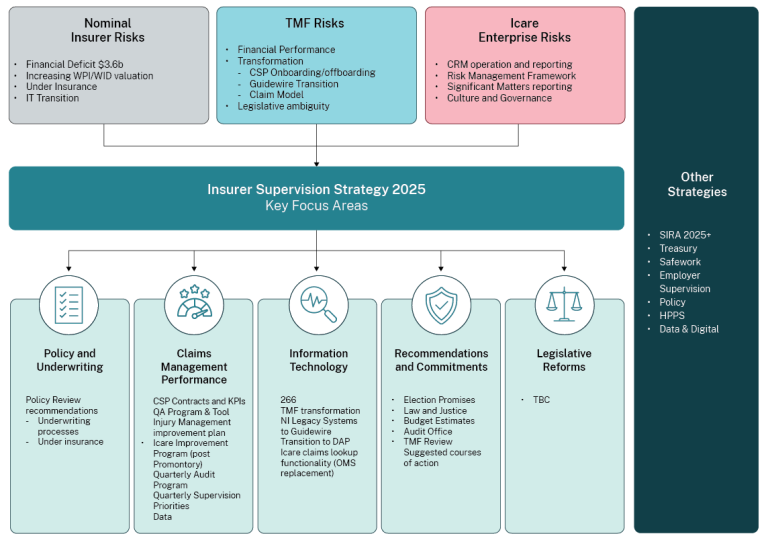
Diagram 1 – High-level strategy
Opportunities
icare has undertaken extensive actions to improve NI performance through the NI Improvement Plan and is currently implementing the TMF Transition Plan. SIRA considers this new collaborative approach as building on the work already undertaken to further improve four key areas of performance across the scheme:
Policy and Underwriting:
Building on the under-insurance review undertaken by SIRA in 2024, which identified prospects for operational improvement in icare underwriting processes and opportunities to better influence employers on the importance of timely information provision to icare. This work will assist in the NI gaining correct premiums from employers, commensurate with the risk those employers represent.
Claims Management Performance:
Within the NI, icare has already implemented significant changes to its claims operational model and the contracting of Claims Service Providers (CSPs) engaged to manage claims. icare is also currently undertaking a similar reform program with the TMF.
There is significant opportunity for SIRA and icare to collaborate to provide clarity, consistency and certainty for CSPs in the delivery of claims management services, aimed at promoting the best outcomes for workers.
Information Technology:
SIRA and icare both have significant IT systems projects underway. This plan will assist in aligning these programs of work to provide certainty and clarity to outcomes.
Recommendations and Commitments:
There have been multiple reviews of the workers compensation system and SIRA and icare’s roles and obligations within this. This plan will ensure that recommendations made, and subsequent actions undertaken by both organisations are clearly documented and aligned, to the betterment of the system.
Legislative Amendments
All amendments to the workers compensation legislative framework will be a focus of work as they are introduced.
SIRA’s Regulatory Framework
The SIRA Regulatory Framework was developed to reflect a customer-centric, intelligence-led and risk-based approach. It establishes a transparent and consistent methodology to regulatory activities, enabling SIRA to meet its objectives and guide where to deploy its resources.
Implementing the Regulatory Framework
The Regulatory Framework identifies four key pillars - Design, License, Supervise and Enforce. These encompass the breadth of regulatory activities SIRA undertakes. Intelligence gathered by Insurer Supervision will also feed directly into the three regulatory framework pillars of Design, Licence and Enforce.
Figure 1 below models the four components of supervision. The insurer is classified based on the overall scheme risk, performance is monitored, and any identified risks are assessed with regulatory action taken where indicated.
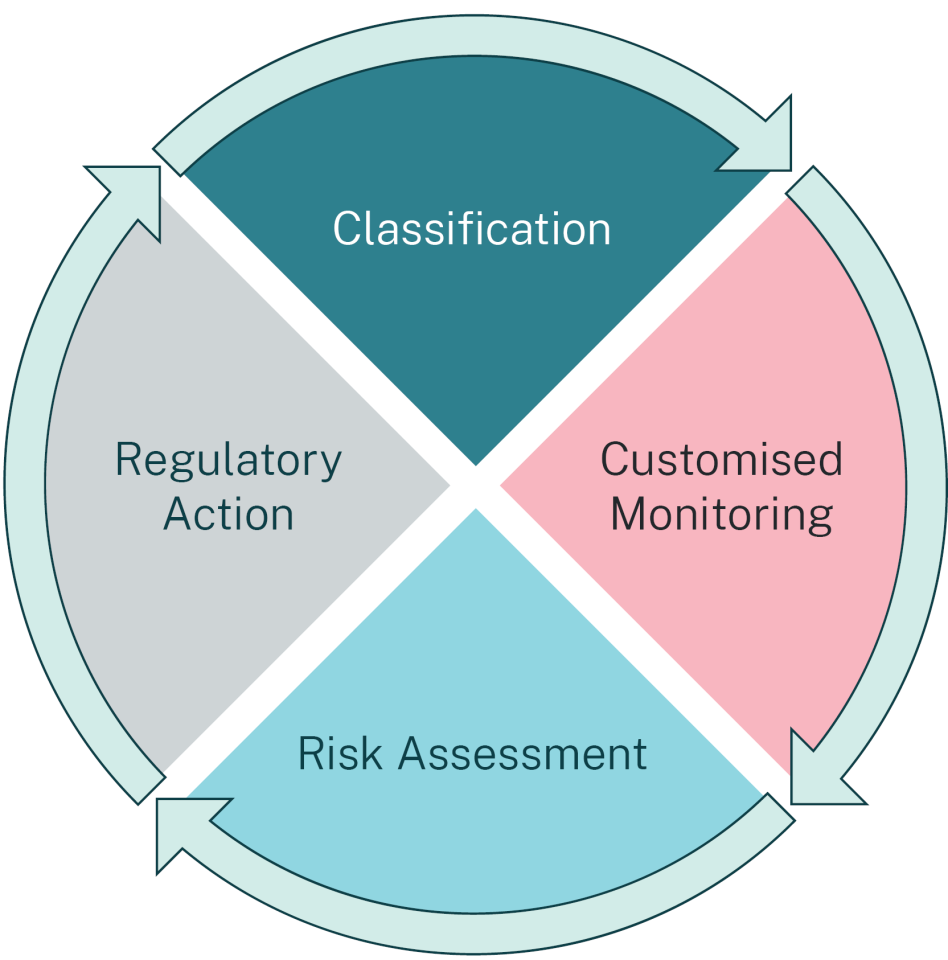
Figure 1: Supervision cycle
The components of the supervision pillar above are supported by the Regulatory Toolkit below. This toolkit includes all the guidelines, policies, processes, tools and artefacts that SIRA uses to regulate with.

Figure 2: Regulatory Toolkit
The toolkit addresses regulatory responses across a spectrum of supervision actions from engagement to penalty. Insurer Supervision will utilise the appropriate elements of the regulatory tool kit (Engagement through to Remediation). Should a potential penalty result from the risk assessment, Insurer Supervision would refer this internally to the Investigations and Enforcement team.
Classification of the NI and TMF
Due to the size and risk to the NSW workers compensation scheme, the NI and TMF retain their own risk classification, requiring bespoke oversight and supervision. This classification impacts the level of customised monitoring, risk assessment and regulatory action phases.
Customised Monitoring of icare
icare is held to account against the following measures:
- Compliance with the Legislative framework
- Claims Performance
- Recovery through work outcomes
- Financial sustainability
- Data accuracy and integrity
- Customer service principles compliance
SIRA monitors icare and the measures above, via information and intelligence received.
| Information Source | Detail |
|---|---|
| Reporting | icare reports to SIRA in line with requirements set out in the NI reporting Framework requirements document |
| Engagement | Board to Board meetings- twice yearly CE-CEO meetings - quarterly Principal Executive meetings – quarterly strategic focus Operational meetings -monthly Meeting with Treasury Specific projects- Data Transformation, Significant matters, collaborative initiatives (early intervention etc.) as required Ad hoc meetings – specific issues Quarterly supervision priorities Weekly insurer communication |
| Auditing Program- Claims and Policy | Quarterly Performance auditing Targeted Audits (eg. indexation) |
| Claims and Policy Data analysis | Error identification and correction Data compliance |
| Complaints and referrals | SIRA Customer service, IRO, Ministerial referrals, Safework |
Risk Assessment
Application of the SIRA: Risk and Issue Assessment tool to all identified and emerging risks provides an overall risk score and guides whether further regulatory action should be taken. All assessments are recorded in the Risk Register. This is reviewed at regular intervals for common themes and insurer behaviours.
Regulatory Action
Regulatory action is based on the risk assessment outcome and the Regulatory tool kit provides the means for this action. A collaboration first approach means that SIRA will in the first instance seek to engage, set expectation and educate to set standards and requirements in day-to-day supervision, guiding insurer actions and behaviours.
Identified breaches with minimal harm outcomes may be monitored for repeat behaviours. For more serious matters, further investigations are undertaken leading to remediation or consideration of formal punitive measures (eg. Letter of Censure, Civil Penalty).
Integration with Regulatory Framework pillars of Design, Licence and Enforcement
Intelligence gathered and identified risks are shared within SIRA for their consideration of the design of the scheme, the licencing of insurers, providers etc.
icare Supervision Strategy 2025
The high-level strategy below asserts the recognised key major risks. The key focus areas have been categorised to address the identified risks, with the classification of specific topics and programs of work.
The focus areas in the Insurer Supervision icare strategy for 2025 are aligned to the supervision pillar of the Regulatory Framework.
Focus Areas for managing icare key risks
1. Policy and Underwriting
Policy review recommendations
SIRA commenced work with a review of under insurance in the NI and Specialised Insurers in May 2024. The final report of the NI review was shared with icare in December 2024.
Insurer Supervision will lead by engaging icare in the development of a plan to address the report’s recommendations. Insurer Supervision will monitor the progress of the plan through agreed reporting and engagement.
SIRA is engaging icare on the introduction of a wage declaration media campaign. icare is supporting this with a direct employer engagement campaign for outstanding insurance premiums. This program of work will continue through 2025.
Any identified premium or policy discrepancies identified during Insurer Supervision quarterly audits of the NI with be raised with icare at the time of the audit.
SIRA will also seek oversight of payment plans put into place between icare and employers who have underpaid premiums over previous years, balancing consideration for individual employers’ circumstances with fairness across the NI scheme.
See Appendix 1 for actions
2. Claim Management Performance
Contracts and KPIs
SIRA will engage and collaborate with icare to understand the NI claims service provider contracts and KPIs.
Insurer Supervision team seeks to identify the levers icare is using to incentivise claims service providers towards better case management and outcomes for the injured workers, employers and the scheme. Opportunities for improvement will be raised with icare.
As of December 2024, icare is finalising an RFP process for TMF claims service provider engagement. SIRA has received the tender document and will be seeking to similarly understand the contracts and KPIs for the TMF CSPs.
The Insurer Supervision team will assess the differentiating and common factors of the NI and TMF claims service provider KPIs.
QA program and tools
icare shared its claims management quality assurance measures with SIRA. These quality assurance measures help inform SIRA of the focus of continuous improvement for claims management in the NI. SIRA will seek to understand how these measures are reflected in the CSP contracts to incentivise better engagement from the CSP.
The current icare QA framework has 7 themes: initial stakeholder contact, liability, payments, strategic planning, injury management planning, claim management and data accuracy.
SIRA will collaborate with icare to align supervision activities to compliment the QA framework, and the insights gained through this process. These insights can then inform further actions to engage with CSPs to drive improved performance.
Insurer Supervision will seek regular quarterly reporting of the QA results for both the NI and TMF schemes. SIRA expects to receive individual claims service provider scores in this reporting.
SIRA can use the scores of icare’s quality measures to inform the collaboration between relevant teams within SIRA and icare to drive improvements in claims management practices.
This quarterly reporting will also help to inform Insurer Supervision’s quarterly audit focus area.
Early intervention and injury management improvement plan
icare has demonstrated its commitment to uplift its and its CSPs capability in the early intervention and injury management of claims.
Insurer Supervision will continue to support Employer Supervision Return to Work and icare to further embed improved early intervention strategies for case managers in the NI scheme. This work is intended to commence with the TMF claims service provider and NSW government employers in 2025.
There is opportunity for Insurer Supervision to engage with icare as to whether any emerging risks in the TMF scheme (outside the IT transformation) have been identified. Further to this, are there plans to implement a TMF specific improvement program replicating that rolled out for the NI.
icare Improvement Program (post Promontory)
SIRA intends to continue to oversee the long-term implementation of the Nominal Insurer Improvement program.
Promontory in its final report of June 2024 reported that 58 of the 63 initiatives and 99 of 107 recommendation as complete and effective.
Insurer supervision team will assess the effectiveness of the activities specific to the NI Improvement program. Engaging with icare and monitoring data will allow ongoing assessments of the effectiveness of the following streams of the NI improvement plan:
- N 1.3 Small employer
- N 1.4 Large employer N 1.5 Mental Health claims
- N 1.6 Work capacity decision making and
- N 1.7 Tail liability management
Quarterly audit
Insurer Supervision will continue conducting quarterly audits of the NI. The focus of each audit will be determined by the risks identified.
SIRA will commence the audit of the TMF in February 2025 by way of a review and then aims for ongoing audits to be conducted quarterly.
The audits provide an opportunity for SIRA to see the improvement initiatives in action and their impact on claims management.
The audits will be used to assess the impact of the NI Improvement Plan and the TMF claims service provider transition to the icare claims management platform in 2025.
Quarterly supervision priorities
The insurer supervision directorate sets quarterly priorities for all the insurers. Insurer Supervision will continue to engage with icare on each supervision priority, assess and report any outcomes from the priority.
Data
Insurer Supervision will continue to assess monthly data for timelines of liability decisions made on NI and TMF managed claims. These data book assessments will be shared with icare and compared to icares’ own data analysis.
Insurer Supervision will continue monitor duplicate and inactive claims on a quarterly basis and engage with icare to seek rationale for the status of identified claims.
Additionally, ongoing quarterly reviews of timeliness of further liability decision after reasonably excusing the workers claim will be maintained. Formal feedback will be provided to icare where extended periods to making a liability decision are identified. The aim is to ensure all workers claims are determined as soon as all information is available to the insurer.
As noted in the previous sections, there will be opportunities to run ad hoc data projects on as need basis to address identified risks in the scheme.
Insurer Supervision will annually review the register of Significant Matters (incepted on 01.03.2024), categorising common themes of insurer behaviour and assessing if any regulatory response is warranted.
A similar review of the NI Risk Register on a quarterly basis to note any themes and determine if regulatory action is required.
Any regulatory action taken against icare will be reported to the SIRA board.
See Appendix 2 for actions
3. Information Technology
icare has commenced the transition of all claims onto a centralised claims management system with a target of completion in 2026. SIRA has been engaged by icare on this project with the following sub-projects to be progressed through 2025:
- Finalisation of the 65,000 plus claims missing from the 266 data previously transitioned to TMF agencies (Jan-Feb 2025).
- Finalisation of the onboarding and data submissions for ULIS on the Guidewire claims management system (Dec 2024)
- Onboarding of the TMF claims service providers on to Guidewire claims management system (from May 2025)
- Transition of open legacy TMF claims onto the Guidewire claims management system (From August 2025)
- Transition of open legacy NI claims onto the Guidewire claims management system (late 2025-early 2026)
SIRA is ceasing the operation of the Claims Data Repository portal and the associated claims lookup functionality in the first half of 2025. icare is currently developing its own system to replace these functions. SIRA and icare are already collaborating in the development of this replacement system and will continue to do so into 2025.
Insurer Supervision will continue to facilitate the engagement between icare and SIRA for these key projects and monitoring the success of these projects.
There is currently no specific coding available within the IT platforms to identify secondary psychological injury. SIRA and icare will collaborate to develop mechanisms to better identify those injuries that have a secondary psychological injury component.
See Appendix 3 for actions
4. Recommendations and Commitments
Over recent years a number of election promises, commitments and recommendations have been made with the aim of improving NSW workers compensation scheme performance. These include:
- Janet Dore, 2019- Independent reviewer report on the Nominal Insurer of the NSW workers compensation scheme
- Hon Robert McDougall QC, 2021 - icare and State Insurance and Care Governance Act 2015 Independent Review
- NSW Parliament Legislative Council Standing Committee on Law and Justice, 2020, 2022 & 2023 - Review of the Workers Compensation Scheme (L&J)
- NSW Auditor General’s Report, Performance Audit 2024 – Workers compensation claims management
- NSW Treasury, 2024 - Operational expenditure review Insurance and Care NSW (icare)
SIRA will collaborate with icare to ensure that all recommendations are being appropriately actioned and that reporting on the recommendations is consistent.
SIRA engages the NSW Government agencies (deemed as self-insurer) to address the recommended actions applicable to the sector. SIRA will collaborate with icare to ensure consistency and transparency in these engagements, along with shared ownership of actions and outcomes.
See Appendix 4 for actions
5. Legislative amendments
All amendments to the workers compensation legislative framework will be a focus of work as they are introduced.
6. Other strategies
SIRA will continue to engage with stakeholders across the workers compensation system to gain intelligence and on the issues facing the scheme and performance of all participating insurers. These include:
- Independent Review Officer (IRO)
- Tripartite meeting with employer and worker representatives
- Industry representative bodies (eg. NIBA, ALA, Law society)
SIRA commits to fully involve icare on significant individual matters or system trends identified in these engagements.
See Appendix 5 for actions.
Appendices
Appendix 1 – Policy and Underwriting Actions
Policy and Underwriting | |
|---|---|
Goal | Action |
The NI implement a remediation plan to locate unprocessed wage declarations and collect outstanding wage declarations for the prior 5 policy renewal years and report quarterly progress to SIRA. |
|
The NI review and enhance its underwriting practices and compliance assurance programs to uplift employer compliance, with a particular focus on:
|
|
Insurers review and update employer correspondence to include clear information on employer premium obligations and financial risks associated with non-compliance. |
|
Where remediation activity is required as result of the audit program and where customers will be adversely impacted, insurers are expected to:
|
|
Appendix 2 – Claims Management Actions
Claims Management Performance
| |
|---|---|
Goal | Actions |
Insurer Supervision seeks to identify and understand the levers icare is using to incentivise claims service providers towards better case management and outcomes for the injured workers, employers and the scheme. |
· |
Promote early intervention with TMF CSPs to influence RTW rates |
|
Ensure icare improvement program is completed |
|
Assess improvements in claims management - Audits |
|
Improved performance - Quarterly supervision priority |
|
Improved claims management (Data) |
|
Simplify and consolidate messaging for case managers. Reduce administrative burden. |
|
Address identified and emerging risks to the scheme |
|
Appendix 3 – Information Technology Actions
Information Technology | |
|---|---|
Goal | Actions |
266 project Finalisation |
|
Transition of TMF, ULIS and NI Legacy claims to icare claims management system |
|
Replacement claims look up functionality for icare |
|
Identification of secondary psychological injury, in accordance with recommendation 5 of 2023 L&J |
|
Appendix 4 – Recommendations and Commitments Actions
Recommendations and Commitments | |
|---|---|
Goal | Action |
Action election commitments and review recommendations |
|
Implement TMF review report suggested courses of action |
|
Appendix 5 – Other Actions
Other strategies
| |
|---|---|
Goal | Action |
External strategic engagement |
|
Updated 1 August 2025